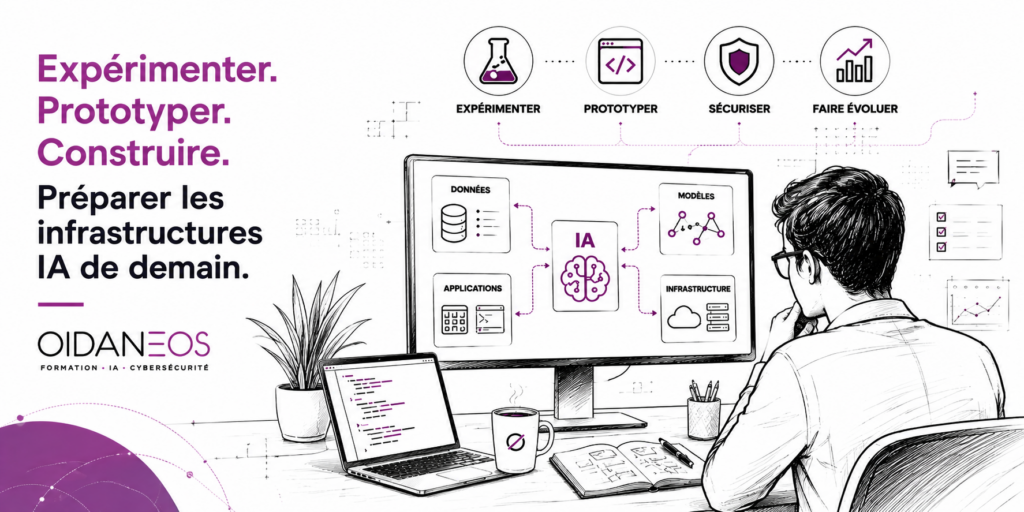
Databases, workflow automations, AI models, business interfaces, hosting, security, compliance, and API costs: an AI initiative quickly becomes a full-fledged digital architecture project.
It is precisely to explore these challenges that OIDANEOS is progressively building its own internal AI experimentation platform.
Moving from Using AI to Building AI Solutions
Today, accessing artificial intelligence is remarkably easy. It takes only a few seconds to open ChatGPT, Claude, Gemini, or Mistral.
However, when a company wants to connect AI to its proprietary data or automate an end-to-end business process, the questions become far more complex:
- Where is the data stored?
- How should it be structured?
- Which AI model should be used?
- How do we connect the various enterprise applications?
- Where should the solution be hosted?
- How do we secure access and permissions?
- How do we control API-related costs?
- How do we ensure compliance with GDPR and the new EU AI Act requirements?
That is the exact moment when AI stops being merely a conversational tool and becomes mission-critical business infrastructure.
02 - ExperimentCreating a Dedicated Environment to Test AI Technologies
OIDANEOS has begun building a dedicated technical environment to host and test various technological building blocks. The approach relies on a dedicated server and self-hostable open-source solutions.
Data & Applications
Baserow to structure databases, Celestory to build interfaces and interactive workflows, Moodle for learning environments, alongside open-source collaborative tools.
Controlled Infrastructure
Containerized deployment via Docker to test multiple isolated architectures and scale solutions progressively.
Sovereignty & Freedom
Rather than relying systematically on external SaaS platforms, rebuilding core components within a controlled, sovereign environment.
Data as the Starting Point
One of our first experiments focuses on databases developed for real-world business use cases. Several involve multiple relational tables that already represent the backbone of a future business application.
The objective is to import this structure, rebuild it within the OIDANEOS environment, and evaluate:
- The relationships between datasets;
- Potential improvements to the relational data model;
- User interfaces that can be tailored for operational teams;
- Workflow automation opportunities;
- How AI systems can interact with this information (RAG, autonomous agents).
Rapidly Developing Business Applications
Generative AI is also profoundly transforming how software applications are built. In our experiments, an interface can now be designed, wireframed, and rapidly turned into a functional application. The underlying code can then be directly refined and enhanced using AI coding assistants.
What this changes: Prototyping a line-of-business application no longer requires launching a heavy, multi-month IT project right away. Organizations can start small—a database, an interface, a first automated workflow—and iteratively scale the solution.
05 - Stay FlexibleTesting Multiple Artificial Intelligence Models
Building your own architecture also prevents vendor lock-in. Depending on the use case, an application can leverage different models from OpenAI, Anthropic, or Mistral, as well as open-source models running in dedicated environments.
This ability to switch models is strategic. Today's leading model will not necessarily be tomorrow's leader. The challenge is therefore not just selecting an AI model, but designing an architecture capable of evolving alongside it.
Train in AI Solution Design
OIDANEOS supports IT professionals in designing and deploying applied AI solutions tailored to their business operations.
Experimentation Must Embed Security by Design
This technical freedom brings new responsibilities. During testing phases, real customer data must never be sent carelessly to external AI services. Data schemas can be replicated and records anonymized so teams can experiment without exposing sensitive information.
Access controls and model API calls must also be strictly governed. A misconfigured application can multiply API requests and trigger excessive token consumption.
A Mission That Goes Beyond Training
This platform also reflects an evolution in how we view our role at OIDANEOS. Training teams on artificial intelligence tools remains essential. Yet organizations increasingly need to go further: understanding how to integrate these technologies into their existing systems, data pipelines, and business workflows.
Our internal platform enables us to test and validate these architectures before deploying them in real-world enterprise contexts:
- Technical Lab: Testing technologies, models, and system architectures.
- Learning Environment: Demonstrating hands-on how the different building blocks work together.
- Prototyping Studio: Progressively turning business use cases into production-ready applications.
Experimenting Today to Build Tomorrow's AI Infrastructure
Artificial intelligence is evolving at breakneck speed. Seeking a permanent, static architecture today would be an illusion. Our approach is therefore deliberately pragmatic:
Test. Measure. Understand. Improve.
Some technologies will fade away; others will become industry standards. AI models will continue to advance. Yet one trend is already clear: enterprises will not settle indefinitely for generic, off-the-shelf AI chat interfaces.
They will progressively build their own tailored environments, connected to their proprietary data and aligned with their core business processes. That is the transition OIDANEOS is committed to exploring today.